
Design of the Scorecard
A Comprehensive Approach
The Regional Government Success Scorecard (RGSS) is one of the most comprehensive scorecards measuring local government performance in Indonesia. It brings together 16 dimensions across 4 pillars, covering what governments achieve, and the capabilities, resources, and operating conditions that shape those results. This allows the RGSS to move beyond a narrow focus on outputs or administrative compliance, and instead provide a more rounded picture of what local government success looks like.
This approach also distinguishes the RGSS from many existing measurements in Indonesia. While a number of current indices provide useful insights into specific aspects of local government performance, they often focus on particular sectors, functions, or administrative processes. The RGSS is intended to be more comprehensive. It covers government capabilities, resource inputs, citizen outputs and outcomes, and the foundational environment within which local governments operate. By combining these components in a single framework, the RGSS is better able to support a fuller understanding of performance and the factors that may be driving it.
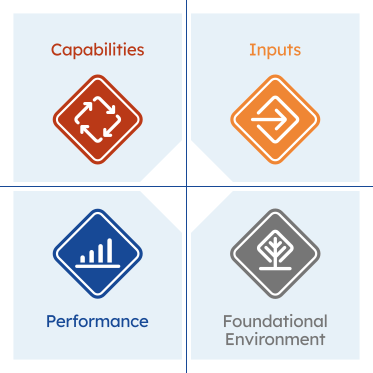
The Regional Government Success Scorecard Framework
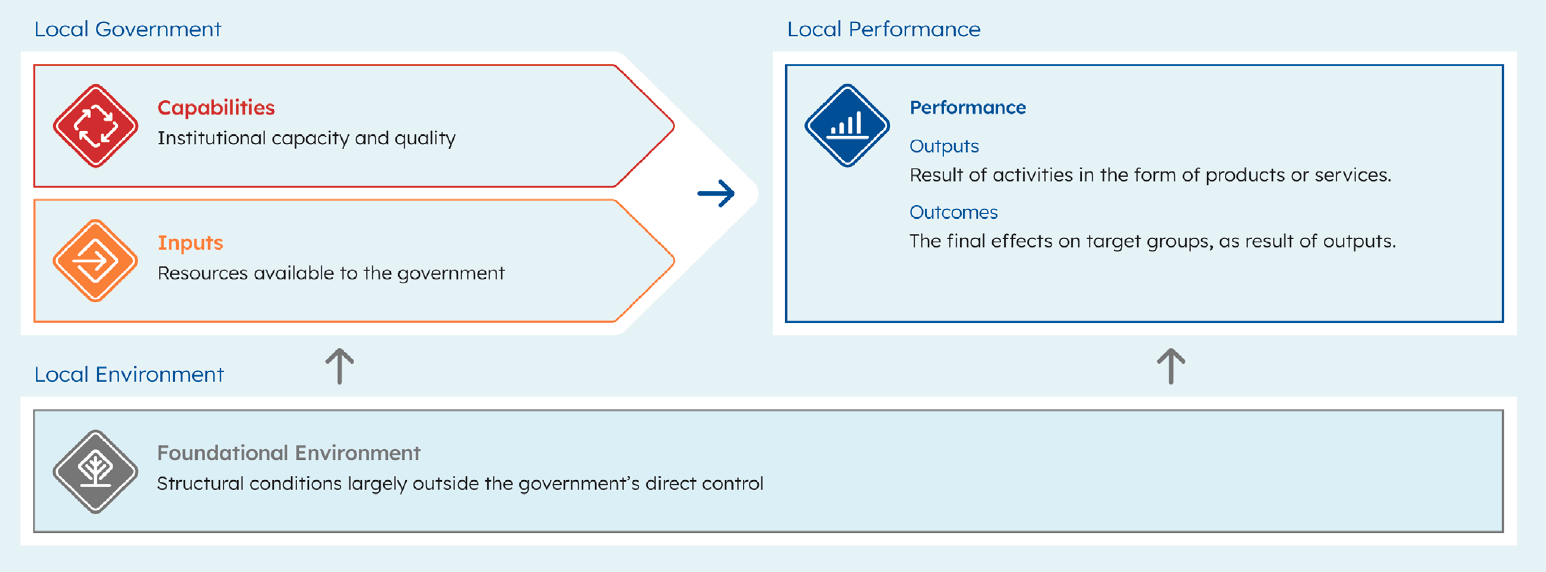
Descriptions of Dimensions for RGSS

Capabilities
Accountability
The strength of a local government’s anti-corruption safeguards and ethical standards.
Financial Management
A local government’s capability to generate revenue, execute its budget, and govern procurement.
Public Service
The quality and efficiency of front-line administrative services provided by local government.
Technology and Innovation
The extent of digital technology adoption and administrative innovation in local government.

Inputs
Financial Resources
A local government’s formally planned annual budget, representing its authorised public resources.
Human Resources
The number of civil servants employed by the local government.

Performance
Attracting Investment
Growth in private investment, reflecting the local government’s effort to improve business environment.
Economic Prosperity
The level of living standards and pace of economic growth within the local population.
Education
The population’s level of educational attainment, measured by years of schooling.
Employment
Local labour market performance, covering job availability, unemployment, and workforce productivity.
Environmental Quality
The ecological health of the local environment, covering air, water, and land quality.
Gender Equality
Women’s political and economic participation, and gender parity in human development.
Health
Population longevity, proxied by life expectancy at birth.
Income & Poverty
The prevalence and severity of poverty, and the degree of income inequality, within the population.

Foundational Environment
Geographic Condition
Inherent geographic and environmental conditions that raise the cost and difficulty of local governance.
Natural Resources
The degree of structural dependence on natural resource endowments.