

Governance Capability, Not Wealth, Predicts How Long Indonesians Live
Kabupaten Lamongan and Kabupaten Sukabumi both sit well below the national average in GDP per capita. Yet their people live longer than in most regencies at comparable levels of development. What they share is not wealth, but the quality of their governance.
This pattern holds across all 514 of Indonesia’s regencies (kabupaten) and cities (kota). The Regional Government Success Scorecard (RGSS) – a new data-driven tool developed by the Chandler Governance Group (CGG), supported by the Gates Foundation, and piloted in Indonesia with Universitas Indonesia – shows that quality of local governance is a far stronger predictor of how long citizens live than the wealth of the region they live in.
Drawing on the most recent year of data available from each source (predominantly 2024), the pilot used nearly 18,000 data points from Indonesian government sources: BPS-Statistics Indonesia, the Ministries of Finance, Home Affairs, Administrative and Bureaucratic Reform (PANRB) and Investment (BKPM), the Corruption Eradication Commission (KPK), the National Public Procurement Agency (LKPP), the National Civil Service Agency (BKN), and the National Disaster Management Agency (BNPB).
What the data shows
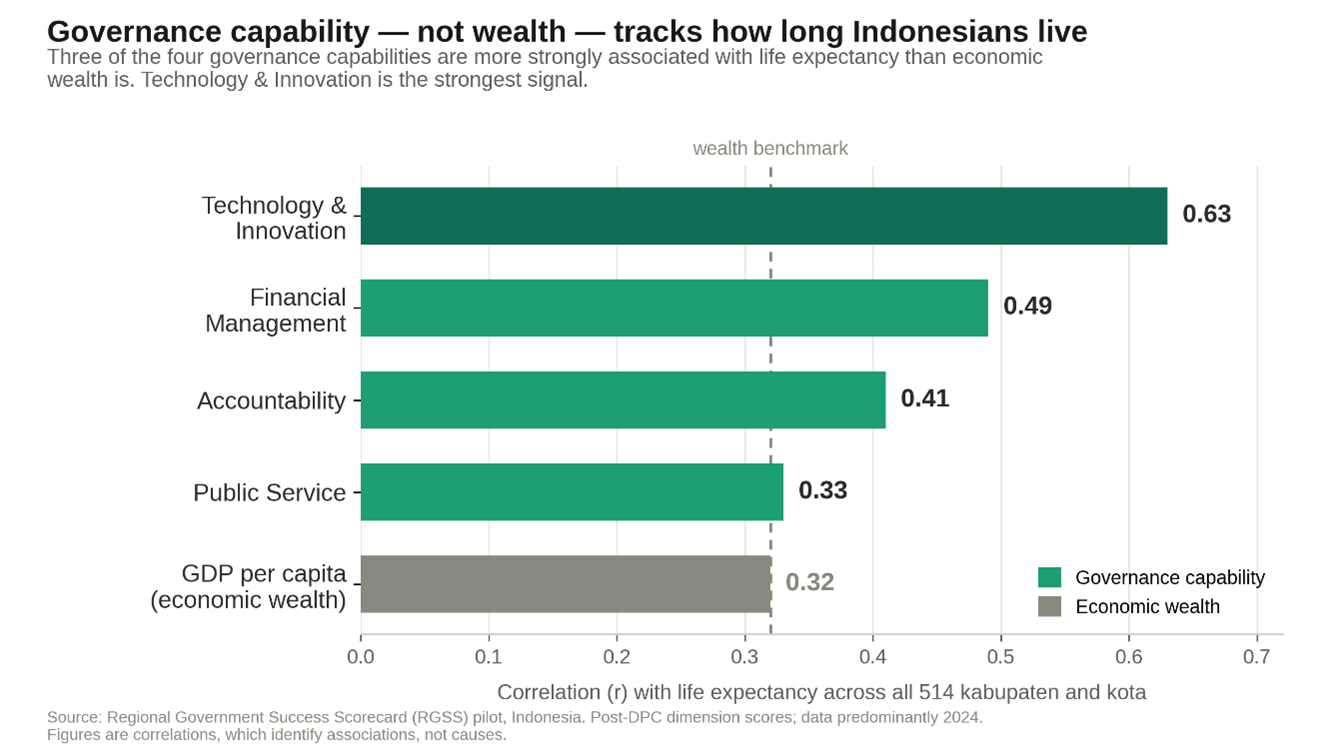
GDP per capita varies enormously across Indonesia – from around Rp 7 million per person in Kabupaten Puncak Jaya to more than Rp 260 million in Kota Surabaya. One might expect wealth to strongly predict how long people live. Yet the correlation between GDP per capita and life expectancy is just 0.32: positive, but modest.
Governance capability is the stronger predictor. The RGSS measures four dimensions of it: Accountability (anti-corruption safeguards and ethical standards), Financial Management (raising revenue, executing budgets and governing procurement), Public Service (the quality and efficiency of front-line administrative services), and Technology and Innovation (the adoption of digital technology and administrative innovation). Each captures a different facet of governance quality. Across all 514 jurisdictions, Technology and Innovation correlates with life expectancy at 0.63 – roughly twice the strength of the GDP link, and consistent across the dataset.
It is the strongest of the four capabilities, but not the only one that matters: Financial Management and Accountability are each more closely associated with life expectancy than wealth is. The broader pattern is clear. It is the quality of governance, not the wealth of a region, that most reliably tracks how long people live.
What this looks like in practice
Kabupaten Lamongan in East Java illustrates the pattern. Its GDP per capita ranks at the 31st percentile nationally, yet it sits in the 98th percentile for Technology and Innovation, the 80th for Accountability, and the 90th for life expectancy. Kabupaten Sukabumi, at the 18th percentile for GDP per capita, ranks in the 96th percentile for Technology and Innovation, the 93rd for Financial Management, and the 95th for life expectancy. In both, governance strength spans more than one capability — and strong health outcomes follow, despite structural economic disadvantage.
These are correlations, not proof of cause. Wealth is itself linked to several capabilities, so the figures cannot fully isolate each one’s effect. Though for Technology and Innovation, life expectancy link holds even after accounting for wealth. The association is also specific to health: the same capability is only weakly related to education or employment, where economic conditions matter more. Life expectancy reflects many influences, and these patterns warrant further research as richer data becomes available.
What this means for planning, investment, and policy
The RGSS gives central agencies, development partners and local governments a more rigorous, structured basis for deciding where capability-building investment will have the most impact. The full dataset for all 514 jurisdictions is public at www.regionalgovscorecard.org.
The RGSS’s contribution is also partly methodological. Rather than ranking every region against a single national average, it uses Dynamic Peer Comparison to judge each kabupaten or kota against structurally similar peers — those with comparable geography and natural-resource conditions — so a remote or resource-constrained region is assessed fairly against its peers, not the largest cities.
It is also designed as a living tool: as better local indicators emerge, its measures of public-service outputs and citizen outcomes can be deepened over time. Built entirely from Indonesian government data in partnership with Universitas Indonesia, its greatest value may lie in giving central and local governments a shared basis for learning from one another, including through the networks and coalitions that connect Indonesia’s kabupaten and kota. Investment in local government capabilities is a promising, evidence-backed route to longer lives.